POWERED by THECREATOR EDUCATION - Cultivating Global Problem-Solvers
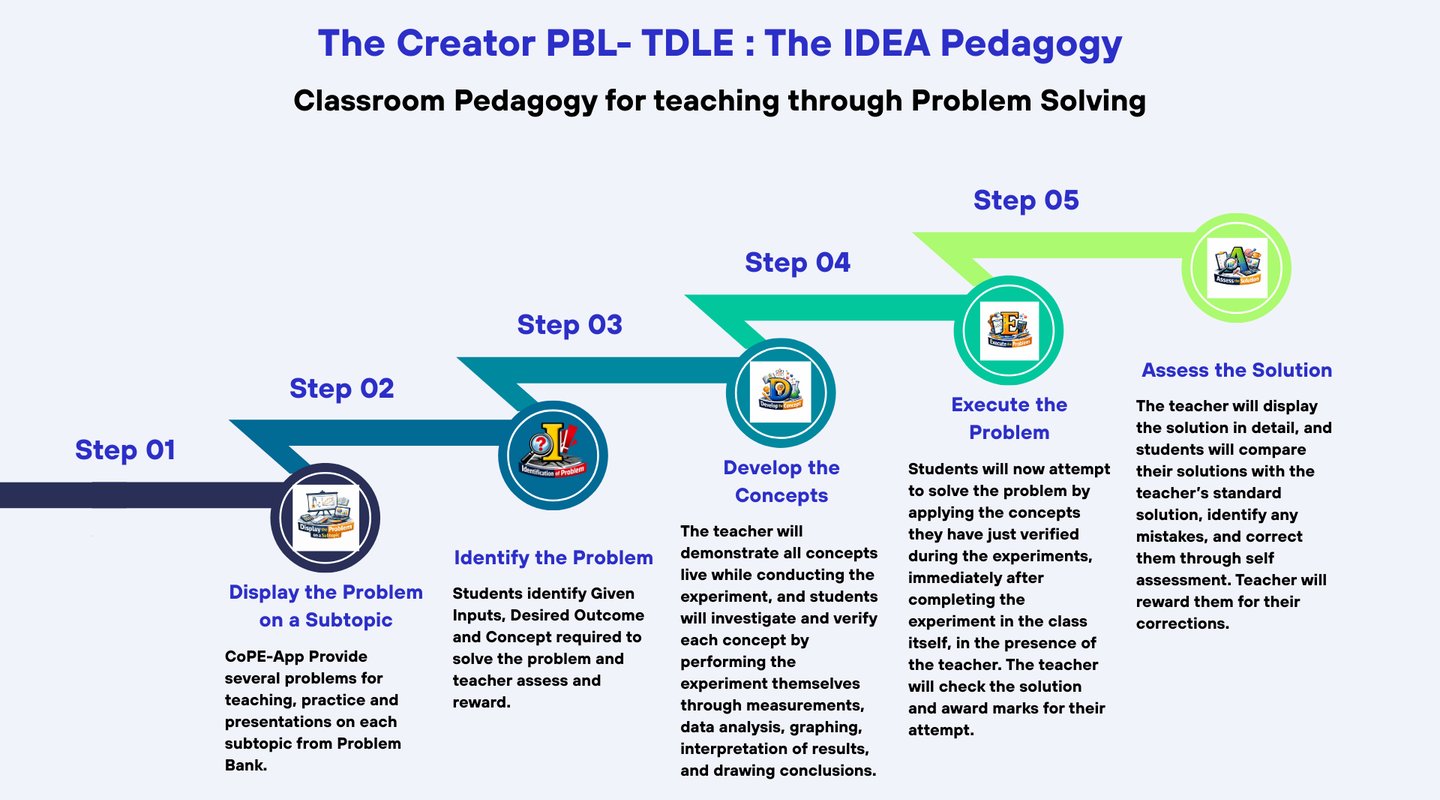
IDEA Pedagogy (Identification–Development–Execution–Assessment)
The software executes every lesson through the IDEA pedagogy specially designed for The Creator PBL-TDLE model, creating a structured cycle of concept mastery and application within the classroom. It begins with Identification of the problem, followed by Development of concepts through demonstrations and experiments, Execution through structured problem solving, and Assessment through continuous verification. Importantly, all four steps are actively performed by students, except the initial demonstration in the concept development stage where the teacher introduces the experimental setup. Students then perform the experiments themselves while the teacher remains present as a mentor to address doubts, guide investigations, and support accurate execution.
During the Development stage, students engage deeply with apparatus, conduct experiments, make observations, record data, and explore concepts through hands-on investigation. This environment provides rich opportunities for interaction, curiosity-driven questioning, and intellectual exploration. Students frequently ask questions related to apparatus, experimental design, and results, and are even encouraged to suggest and test new experimental ideas. Such active participation enhances research aptitude, creativity, and scientific thinking right at the school level.
At every step of IDEA, teachers continuously evaluate student performance and award marks based on their approach, accuracy, reasoning, and execution. If any misconception, error, or incorrect method is observed, the teacher immediately provides corrective feedback, allowing students to rectify their work on the spot. This real-time correction ensures that mistakes become learning opportunities rather than final judgments, making the assessment process highly supportive and developmental.
I.D.E.A Steps for Problem Solving
I — Identify the Problem
(Problem Identification and Analysis)
Learning does not start with textbooks or readymade information.
A real problem is presented first, which cannot be solved by content recall alone.
Students identify
given inputs
desired outcomes
concepts they already know
concepts they do not yet know but are required
Students ask why, how, and what principles govern the situation.
D — Develop the Concepts
(Concept Development through Investigation)
All required concepts, including those emerging from student questions and the syllabus, are developed.
Teacher demonstrates concepts using real time experiments.
Students actively investigate, experiment, and verify each concept themselves.
Concepts are constructed by linking observations, experiments, data, and reasoning.
Learning is verified, not assumed.
E — Execute the Problem
(Make strategy, Apply concepts to solve problem)
Concepts are developed to the level where students can confidently apply them.
Students solve problems displayed by the teacher in the classroom.
The same concepts are applied across multiple contexts to strengthen transfer and retention.
Students solve three levels of problems with increasing depth and complexity.
A — Assess the Solution
(Ensuring learning is correct, complete, and internalized)
Student solutions are evaluated immediately by the teacher.
Errors are corrected by students on the spot through discussion and reasoning.
Students assess their own solutions, refine them, and take ownership of learning.
Higher order thinking develops through justification, correction, and reflection.
Students present their solutions for peer review and classroom assessment.
Our office
Near DurgaShakti Foods Pvt. Ltd.
Sajanpuri, Khamgaon, M. S. 444303
Contacts
thecreator.school@gmail.com
9172221415 /16/18
Cultivating Global Problem-Solvers